

Beyond Bloom: Rethinking Cognitive Pathways and Sustainable Knowledge in an AI-Powered Classroom
- Hatem Radwan
- Dec 4, 2025
- 4 min read

Inspired by Dr. Saleem Hamady’s EdTALK Coffee session
Written for school leaders, educators, policymakers, and EdTech innovators

Introduction: A New Cognitive Reality
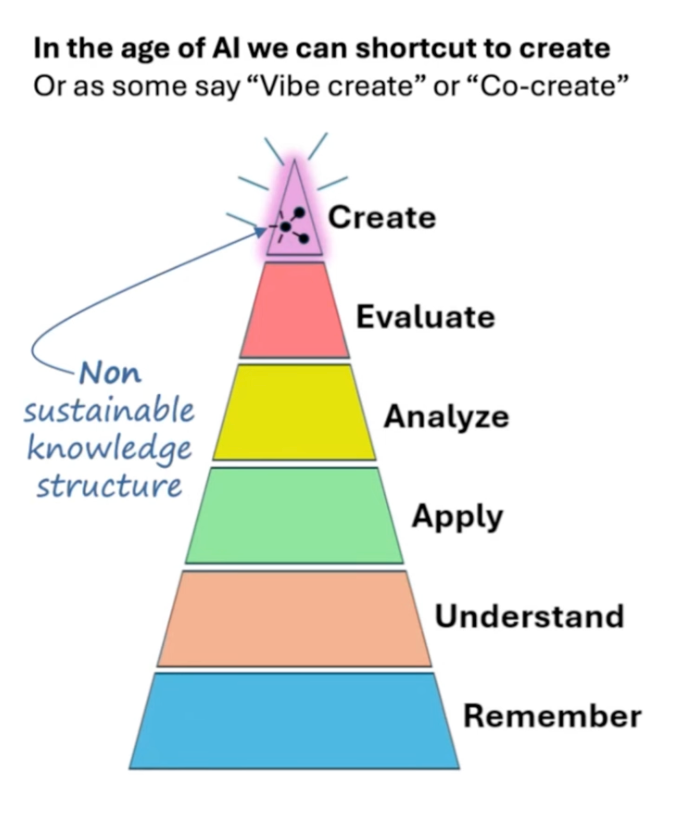
For decades, Bloom’s Taxonomy has guided educators in designing learning outcomes, structuring thinking skills, and planning instruction. It provided a clear pathway:remember → understand → apply → analyze → evaluate → create.
A progression.A hierarchy.A journey that made sense.
But today’s classrooms are entering a radically different cognitive landscape.
AI tools can generate essays, solve equations, design presentations, simulate concepts, and create products instantly. Tasks that traditionally took hours of human thinking can now be produced in seconds. In other words:
👉 Students can now “create” without ever truly learning.
This shift forces us to ask a critical question:
Is Bloom’s hierarchy still meaningful in an age where AI can leap straight to the top?
Dr. Saleem Hamady, in his EdTALK Coffee session, offered a powerful re-examination of Bloom through the lens of AI — and in doing so, opened an entirely new conversation about cognitive sustainability, learning pathways, and what deep learning must look like going forward.
This article synthesizes that conversation and expands it for school leaders and educators navigating the future of learning.
1. Bloom Was Never Meant to Be a Ladder
One of the most important reflections Dr. Saleem shared is this:
✨ Bloom is not a prescription. It's a framework.
✨ It was never meant to be a rigid step-by-step ladder.
✨ Its power lies in defining cognitive levels, not dictating teaching sequences.
But over the years, Bloom accidentally became:
a staircase to climb
a checklist to complete
a formula for lesson planning
And naturally, a belief formed:students must master the bottom before reaching the top.
Yet what happens when AI can jump to the top immediately?
Create → Without understandingDesign → Without analyzingProduce → Without applyingSolve → Without thinking
This is the disruption at the heart of the AI era.
2. AI Breaks the Pyramid — And That’s Not the Problem
AI disrupts Bloom because it can instantly perform “higher-order” skills:
generate new content
design diagrams
simulate physics
draft essays
produce presentations
Students can now create without cognition.
But Dr. Saleem reminds us:👉 The pyramid was never the goal. The journey was.
The value of learning has never been the final product — it has always been the process of:
struggling
thinking
connecting
revising
reflecting
internalizing
When AI removes struggle, it risks removing meaning.
So the challenge is no longer “How do we get students to the top of Bloom?”The challenge is:
💡 How do we protect the thinking journey when AI can shortcut it?
3. Sustainable Knowledge: The Skill Students Can’t Skip
Dr. Saleem introduces a powerful idea:
Sustainable Knowledge Structures
Learning that lasts, transfers, connects, and supports real-world application.
Sustainable knowledge requires:
multiple exposures
conceptual layering
making sense — not just producing outputs
connecting dots across topics and experiences
reflection and refinement
deep cognitive engagement
But here’s the danger:
👉 AI lets students finish tasks without constructing knowledge.👉 Products are created but understanding is absent.👉 Outputs exist but internal frameworks do not.
This leads to what Dr. Saleem calls:
Unsustainable learning — impressive outputs with zero foundations.
In the real world, such knowledge collapses instantly.
4. The Journey Matters More Than the Destination
In one of the most memorable insights from the session, Dr. Saleem compares Bloom to a simple life moment:
The purpose of having coffee with someone is not the coffee — it’s the conversation.

Likewise in learning:
👉 The purpose of teaching is not the final product — it’s the thinking students build along the way.
AI can give them the “coffee.”But it cannot create the “conversation.”
This reframes the entire purpose of education:
Not to push students toward creating.
Not to measure performance by output alone.
Not to mistake polished work for deep learning.
Instead:
The goal is to cultivate thinking habits that remain long after AI tools change.

5. Rethinking the Cognitive Journey in the AI Era
So how do we adapt Bloom for an AI-driven classroom?
Dr. Saleem proposes a simple but profound shift:
AI doesn’t eliminate the journey — it changes the direction.
Traditionally:students move upward → remembering to creating
In the AI era:students may start at the top → then move downward
They may generate something first (with AI),but then deepen the learning by:
examining how it was built
breaking it apart
challenging assumptions
analyzing errors
reconstructing the logic
mapping the conceptual foundations
This mirrors how professionals work today:
➡ AI drafts➡ humans refine, evaluate, and validate
The skill isn’t creation —the skill is cognition.
6. What Educators Must Do Next
To ensure sustainable learning in an AI-powered classroom, educators must:
1. Redesign assessments
Move from product-based evaluation to process-based evaluation.
2. Ask thinking questions AI cannot answer
“What made you choose this approach?”“How do these ideas connect?”“What are the assumptions behind this model?”
3. Use AI as a thinking partner, not a shortcut
Let students use AI to generate… and then interrogate the results.
4. Prioritize metacognition
Students must learn to explain how they think, not just show what they produced.
5. Teach students how to build sustainable knowledge
Help them connect ideas across time, not treat learning as isolated tasks.
6. Shift the culture of learning
Value:
curiosity over completion
reflection over speed
depth over polish
durability over performance
7. The Future Is Not Anti-AI — It’s Pro-Intelligence
AI is not the enemy of deep learning.It’s a catalyst for redefining it.
With thoughtful design, AI can:
enhance conceptual learning
offer rich simulations
produce visualizations that deepen understanding
free time for more thinking and dialogue
support differentiated instruction
But only if educators remain intentional.
As Dr. Saleem notes:
AI should amplify what humans do best — not replace the thinking we must protect.
Conclusion: A New Cognitive Blueprint for the Future
Bloom’s Taxonomy is not obsolete — it is awakening.
AI forces us to:
rethink the hierarchy
reexamine the purpose
redesign the journey
protect cognitive development
elevate the meaning of understanding
The future classroom must not choose between AI and human learning.
It must unify them.
Because while AI can create remarkable outputs,only humans can create sustainable understanding.And that is where true education lives.
Watch Full Episode here:


Comments